
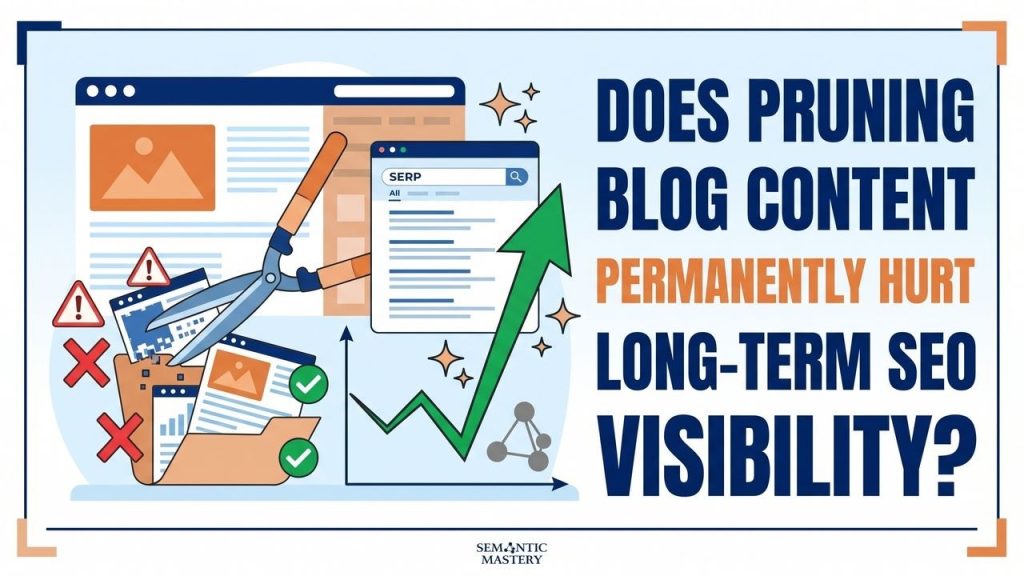
No, not when we prune with a clear purpose. For a local business website, removing or moving the wrong blog content can actually improve long-term SEO performance. The real question is not, “Will we lose traffic?” The question is, “What kind of traffic does this business need?”
A local service company needs nearby people who are ready to call, request an estimate, or book a service. That is very different from getting broad traffic from people across the country who are only looking for general information.
When a local site becomes packed with informational blog posts, it can lose focus. The site may get more visits overall while getting fewer leads from its actual service area. That is why content pruning can make sense.
Table of Contents
Traffic Is Not the Same as Leads
It is easy to look at a rising traffic graph and think everything is working. But traffic alone does not pay the bills. A local business needs traffic with local and commercial intent.
For example, imagine a home remodeling contractor in Washington, D.C. Its main goal is to rank for services such as kitchen remodeling, bathroom remodeling, or flooring installation in its local area.
Now imagine that same website has published dozens or hundreds of articles such as:
- Five flooring types for a high-end kitchen remodel
- How to choose cabinet colors
- Popular remodeling design ideas
- How much does new flooring cost?
Those articles may bring in a lot of search traffic. But much of that traffic may come from outside Washington, D.C. People may be researching ideas, not looking to hire that contractor. The blog gets clicks, but the business may not get calls.
That is the problem. We can have a website that looks busy in analytics but does not help the local business win more customers.
Local Service Site or Informational Blog?
Google appears to look at the overall purpose of a site. Is it mainly a local service business website? Or is it mainly an informational resource?
When a local business has more blog content than core pages, its signal can become muddled. The root domain may begin to look more like a blog than a local services site.
This matters because the pages with the strongest business goal are usually the service pages. These pages target bottom-of-funnel searches, meaning searches from people who are closer to taking action.
Examples include:
- Kitchen remodeler in Washington, D.C.
- Bathroom renovation company near me
- Local flooring installer
- Emergency plumbing repair in Arlington
Those are commercial searches. The person behind the search is often ready to contact someone.
Blog posts tend to target top-of-funnel or middle-of-funnel searches. These are broader searches from people who are learning, comparing options, or looking for ideas. Those searches are not bad. They simply serve a different purpose.
If the root domain is meant to generate local leads, then its content and site structure should keep pointing Google toward that purpose.
Got SEO Questions? Get answers every week at 4pm ET at Hump Day Hangouts. Ask questions ahead of time, or live – just go to: https://semanticmastery.com/hdho (bookmark this!) 10+ years of insights given every week!
Get your checklist to help get better results with GBPs, faster.
Need DFY services for you Local SEO projects? Head over to Semantic Links.
Why So Many Agencies Sell Blog Posts
We understand why agencies offer ongoing blog posts. Blogging is a repeatable monthly service. It is easy to package, easy to explain, and can create recurring revenue.
But a deliverable is not automatically a good strategy.
Many local SEO campaigns keep publishing posts because “more content” sounds like growth. The issue is that the content often overlaps with pages that already exist on the site.
For example, a roofing company may already have a strong page for roof repair in its city. Then it publishes articles targeting phrases that are very close to the same topic:
- Signs you need roof repair in the city
- Affordable roof repair services in the city
- When to call for roof repair locally
- Roof repair tips for homeowners in the city
At first glance, that may seem helpful. In reality, these pages can compete against the main roof repair page. Google has to decide which page is the best match for a similar search. Instead of one powerful page ranking well, several pages may weaken each other.
How Competing Pages Hurt Local SEO
When several pages on the same domain target nearly the same service, location, or search intent, we can create competing page issues. This is often called duplicate or overlapping content.
We are not talking about content published on separate websites. Content on another domain is not the same type of duplicate content issue. The bigger concern here is multiple pages on the same website trying to rank for closely related terms.
The result can be messy:
- The main service page may lose rankings.
- A weaker blog post may rank instead of the conversion page.
- Google may switch between pages in search results.
- None of the pages may perform as well as one focused page could.
- Lead generation can drop even if total traffic rises.
A service page should have a clear job: help a local prospect understand the offer and take the next step. That might be making a phone call, filling out a form, or requesting an estimate.
If a blog post wins the ranking but does not make the service clear or guide people to contact the company, it can become a poor replacement for the page that should have ranked.
The Tipping Point: When the Site Loses Its Focus
There can be a tipping point. A site may publish informational posts for months or even years. The more often it publishes, the faster this can happen.
Eventually, the website may have far more content aimed at broad informational searches than content aimed at local buying searches. At that point, Google may see a heavier informational focus across the site.
That does not mean the website has no visibility. In fact, it may receive plenty of organic traffic. It just may be the wrong traffic for a local company.
We should not judge local SEO by traffic volume alone. We should look at whether core service pages receive impressions, clicks, calls, form submissions, and qualified local leads.
A hundred local prospects can be far better than ten thousand broad informational visits.
Prune or Move Content Based on Intent
Content pruning does not have to mean deleting everything. Before we remove a page, we should decide what job that page is supposed to do.
If the business wants broad informational traffic and plans to use it, then keeping the blog may make sense. In that case, removing the content could reduce that informational visibility.
But if the root domain needs to work as a local lead-generation site, moving informational content away from the main site can be the better choice.
We have a few practical options:
- Remove weak or redundant posts. If a post overlaps heavily with a service page and adds little on its own, pruning it may help the site become clearer.
- Move blog content to a subdomain. A subdomain can hold informational articles while the root domain stays focused on local services.
- Use branded external assets. Informational content can be republished or migrated to branded web properties instead of sitting on the core local site.
- Support those assets properly. Add useful content to them and build links to them when appropriate. Using both on-page content and off-page signals is generally stronger than using only one.
This approach gives us more control. The root domain can focus on the services that bring in leads. Meanwhile, informational content can still attract a wider audience from a separate place.
A Better Way to Keep Both Benefits
We do not have to choose between local service SEO and informational content. We simply need to place each type of content where it makes sense.
A strong structure could look like this:
- Root domain: Local service pages, location pages, contact pages, and content built to support conversions.
- Subdomain: Broader guides, educational articles, and blog content that targets informational searches.
- Branded web properties: Selected informational articles that can build topical reach without competing with the main site.
By separating these goals, we can avoid forcing one website section to do two very different jobs. The local service site remains focused on nearby customers. The educational content can still exist and attract broader search traffic.
For more local SEO resources, including prospecting, GBP optimization, and link building tools, grab the Local SEO Toolkit.
Make the Decision From the Business Goal
There is no one answer for every website. Content pruning is not automatically good or bad. It depends on the intent behind the site.
If the goal is to be an informational blog, then keep and grow the informational content.
If the goal is local leads for a service business, then make sure blog content does not drown out service pages, compete with them, or pull the site away from its commercial focus.
We should ask one simple question before adding, deleting, or moving a page:
Does this content help the root domain become a better local service website?
If the answer is no, the content may belong on a subdomain or branded external asset instead.
Frequently Asked Questions
Will pruning blog posts permanently damage SEO?
Not necessarily. For a local services site, pruning or relocating overlapping informational posts can improve the performance of the pages meant to generate leads. It may reduce broad informational traffic, but that can be a good trade if local commercial visibility improves.
Should a local business stop blogging completely?
No. Blogging can still be useful. The key is to avoid publishing posts that compete with core service and location pages. Broad informational articles can also be placed on a subdomain or branded external assets.
What is a competing page issue?
It happens when multiple pages on the same domain target very similar topics, services, locations, or search terms. Google may struggle to choose the best page, which can weaken rankings across the group of pages.
Why can high organic traffic be bad for a local business?
High traffic is not bad by itself. It becomes a problem when most visits come from people outside the service area or from people who only want general information. Local businesses need qualified traffic that can turn into calls, estimates, and customers.
When should we use a subdomain for blog content?
A subdomain can make sense when the main domain needs to stay focused on local services, but the business still wants to publish educational content for broader searches. It helps separate informational intent from local lead-generation intent.