
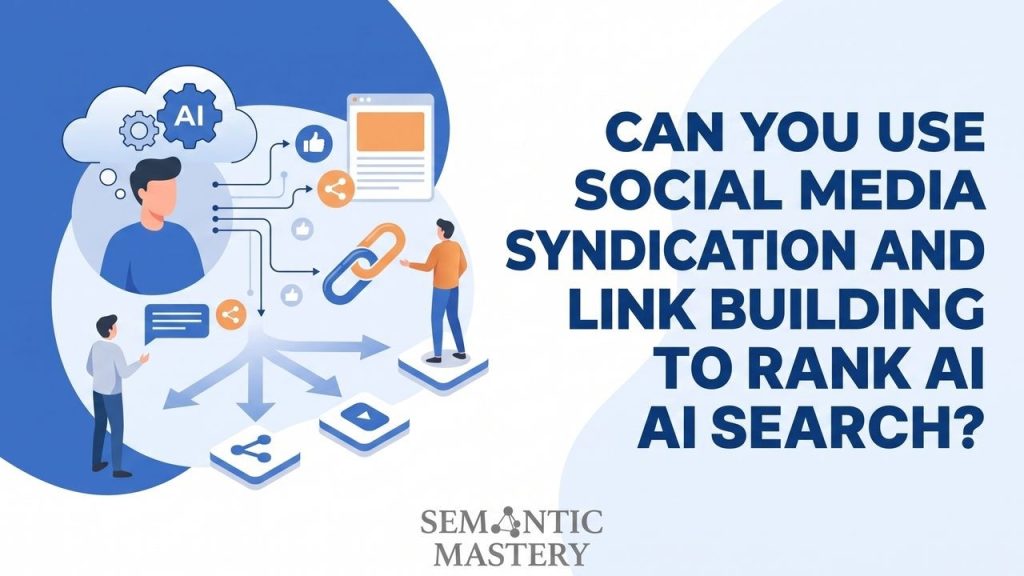
YouTube is showing up often in Google AI Overviews and AI Mode. That raises a fair question: can we create content around relevant keywords, share it across social sites, and build links to those posts to improve our reach?
We need to split that question into two parts. Content syndication still makes sense. Bulk link spam is a different story. We can use automation to spread our content without going back to old tactics built around huge numbers of unrelated links.
We have taught RSS-based syndication since 2015. The tools and plans have changed, but the basic process is much the same. What has changed is how we approach the links behind those networks.
RSS Syndication Still Has a Place
Syndication means publishing our content through other connected sites. Instead of posting a blog article or video by hand on every platform, we set up a system that shares new content for us.
Our early training on this was called IFTTT SEO. It later became Syndication Academy, and that same basic approach continues through Brand Expander. The process has always centered on connecting a content source to a group of publishing sites.
Those sites can include blogs, social profiles, and bookmarking sites. Depending on the connections a tool supports, possible destinations include:
- Blogger
- WordPress.com
- Tumblr
- Facebook pages
- X
The benefit is simple: we publish once, then let the system handle the connected actions.
That gives us a way to distribute keyword-focused content across more places. But we should not confuse wider distribution with a promise of AI search rankings. The fact that YouTube appears in AI answers does not mean every syndicated post will earn a citation.
How IFTTT Connects the Pieces
IFTTT stands for “If This, Then That.” It uses a trigger and an action. When the trigger happens, the action follows.
For RSS syndication, the trigger is a new item in a feed. The action is to publish that item through a connected account.
A simple setup looks like this:
- We publish a new post on our main blog.
- The RSS feed adds the new item.
- IFTTT detects it.
- A connected action republishes the content to another platform.
Each automation is called an applet. These used to be called recipes. We can create applets for the different publishing actions we want to run.
We Can Use YouTube as a Trigger, Too
For videos, we can use a YouTube channel’s RSS feed or a supported channel trigger. A new upload can then start actions that share the video through connected properties.
The idea is the same as blog syndication. The new upload starts the process, and the applets carry out the publishing tasks.
We do need to check the connections currently available. A network can only automate the actions its tools and connected platforms support.
Got SEO Questions? Get answers every week at 4pm ET at Hump Day Hangouts. Ask questions ahead of time, or live – just go to: https://semanticmastery.com/hdho (bookmark this!) 10+ years of insights given every week!
Get your checklist to help get better results with GBPs, faster.
Need DFY services for you Local SEO projects? Head over to Semantic Links.
Choose the Right Setup for Client Accounts
IFTTT’s plans and applet limits have changed over the years. We once had access to unlimited free applets. That is not the setup we should assume today.
Rather than build a service around an old price, we should check the current limits and match them to our workload. A plan with a small applet allowance may work for one client but not for an agency.
We have two main choices:
- Separate client accounts: Each client pays for a subscription, and we set up the automations. Their network stays in its own account.
- One agency account: We own and manage the account, with enough applet capacity to support several clients.
If we use one agency account, we need room for all the actions across all client networks. If we use separate accounts, we keep each client’s setup apart from the others.
We can also buy prebuilt syndication networks through marketplaces such as Legiit or Fiverr. That is an option when we would rather not build every property and connection ourselves.
Branded Networks and Persona Networks Are Different
Before we discuss links, we need to know what kind of network we are using.
A branded network contains properties set up for the business. These might be social accounts, hosted blogs, or other profiles that carry the brand’s name and identity.
Our advice is clear: we should not point bulk spam links at branded assets. We can syndicate content to those properties without treating them as targets for aggressive link tests.
A persona-based network uses separate profiles rather than the business identity. In the older model, we might build a profile around a person interested in topics related to the business. Those properties served as supporting distribution points.
That difference mattered to the old strategy. The branded network represented the business. The supporting networks were where bulk link tactics were often used. But being separate from the brand does not make those tactics our current recommendation.
How the Old Bulk Link Strategy Worked
Years ago, we used syndication networks as part of a much more aggressive link-building system. The goal was to send large amounts of link equity through supporting properties to the main website.
Link equity means the ranking value that links may pass between pages.
The path worked like this:
- We published a blog post on the main website.
- That post linked to a target page, such as a service or location page.
- The post went out through RSS to supporting network sites.
- Bulk link tools built links to those network properties.
- The links within the syndicated posts pointed back to the target page.
Tools such as GSA, SEnuke, and Money Robot were used to build huge numbers of links. Some campaigns sent hundreds of thousands, or even a million links, toward a network.
The thinking was that hosted properties on large platforms could take that volume. The spam links did not point straight at the main site, but the syndicated content still gave link equity a route back to it.
That is how we used to work. It is not what we recommend now.
Why We Focus on Relevant Links Now
We stopped using bulk link spam years ago. Our focus moved to branded links and links with a clear topical or local connection.
Link volume alone is not the goal. A large pile of unrelated backlinks does not give us the same thing as links that fit the subject or place we serve.
Bulk tools do not give us that level of relevance. That is why we no longer build our approach around them.
We should also be careful with the idea that supporting properties fully separate our website from spam. If a syndicated post links directly to an important website page, there is still a path back to that page.
For anyone testing older methods, non-branded properties are distinct from business assets. Even then, we would not recommend pushing unrelated link equity through content that links directly to the main site.
Keep Distribution and Link Spam Separate
Our approach is straightforward: we can create relevant posts and videos, use RSS and IFTTT to share them, and manage those connections at a scale that fits our business.
Then we treat link building as a separate task, with a focus on brand, topic, and location rather than raw numbers.
Syndication still helps us distribute content. We do not need to attach an old bulk spam strategy to it just because AI search has made YouTube more visible.