
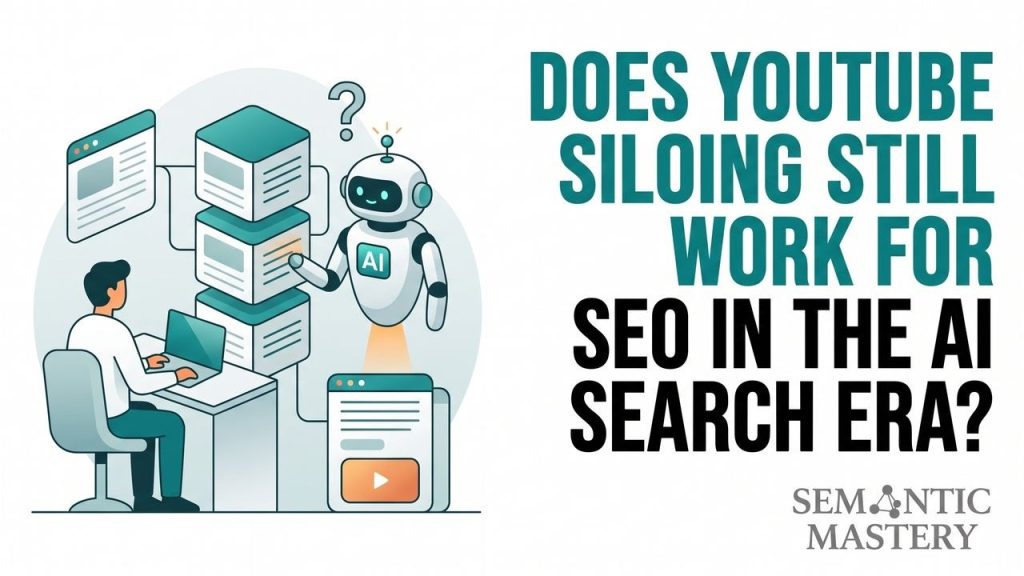
YouTube siloing still has a role in SEO, but we need to be clear about what it can do. A well-built playlist helps us group related videos around a topic, a place, or both. AI has not changed that basic setup.
What has changed is the weight of different ranking signals. For performance within YouTube, engagement matters much more than it used to. On-page SEO and links still have a place, but we should not expect them to do the same job they did years ago.
The short answer is simple: we do not need a new silo structure just because AI is here. We need to keep our content organized, optimize it well, and focus on the signals that matter for our goal.
What Has Changed in YouTube SEO?
Years ago, traditional SEO signals had more influence on YouTube performance. That was the setting in which our original YouTube silo training was built.
Those signals have not become useless. But YouTube is now much more driven by engagement. That means we need to look beyond how well we optimize a video or how many links point toward it.
The engagement signals we pay attention to include:
- Thumbnail click-through rate: How often people click through to a video after seeing its thumbnail.
- Watch time: How much time people spend with the video.
- Returning users: Whether people come back for more content.
These signals tell a different story from a keyword or a backlink. They show how people respond to the content itself.
That is why we cannot treat a playlist structure as the whole strategy. We can organize everything well and still need stronger engagement. The structure supports our work, but it does not replace content that earns clicks and holds attention.
A YouTube Silo Is Still a Playlist Container
The word “silo” can make this sound more complex than it is. In practical terms, a playlist is a container for individual videos.
We optimize that container around a clear theme. Then we add videos that fit the theme and optimize those videos as well.
The focus can be:
- A topic: Videos that cover the same subject.
- A geographic area: Videos tied to the same location.
- A topic and a location: Videos that share both a subject and a local focus.
The main point is relevance. The videos inside the playlist should belong together. A playlist name alone does not make unrelated content part of a useful silo.
We also need to work at both levels. Optimizing the playlist does not remove the need to optimize each video. Each video should have a clear focus of its own while still fitting the wider playlist theme.
That process has not changed because of AI. We still create the container, choose related content, and keep the on-page information aligned.
Got SEO Questions? Get answers every week at 4pm ET at Hump Day Hangouts. Ask questions ahead of time, or live – just go to: https://semanticmastery.com/hdho (bookmark this!) 10+ years of insights given every week!
Get your checklist to help get better results with GBPs, faster.
Need DFY services for you Local SEO projects? Head over to Semantic Links.
Where Link Building Fits
One reason to group related videos into a playlist is that we can build links to the playlist itself. Those links can potentially benefit the videos within that container.
But we need to keep that benefit in perspective. Link building does not carry the same weight for YouTube performance that it once did. It should not become our answer to every performance problem.
If our plan depends mostly on links pushing a playlist higher within YouTube, we are giving older SEO signals too much weight. Engagement now deserves much more of our attention.
This does not mean we should stop optimizing playlists or ignore links. It means we should give each part of the strategy the right role. A clean silo can support relevance. Links can support SEO. Neither removes the need for people to click and spend time with our content.
YouTube Rankings and Google Rankings Are Different Goals
We also need to separate two goals that often get mixed together: better performance inside YouTube and better rankings for a YouTube video in Google Search.
They involve the same video, but we should not treat them as the same task.
For Performance Within YouTube
Our main focus should be engagement. We still optimize the video and playlist, but we place more weight on clicks, watch time, and return visits.
On-page SEO remains part of the work. It simply is not the whole engine behind performance.
For Visibility in Google Search
Traditional SEO signals still have a clearer role when our goal is to rank a YouTube video in Google’s organic results. Links and other SEO work can help support that goal.
So before we change a silo or start building links, we should ask: Are we trying to improve performance within YouTube, or rank the video in Google Search?
That question helps us choose where to put our effort. Without it, we may use a tactic suited to one goal and expect it to solve a different problem.
How AI Helps Without Changing the Structure
AI gives us a faster way to handle parts of the optimization process. It does not create a new set of rules for how a YouTube silo should be built.
We can use AI to help with:
- Keyword research tied to the playlist’s focus.
- Recommendations for on-page improvements.
- Updates to video and playlist information.
These are ways to make the existing work more efficient. The underlying task stays the same: make the topic clear and keep the content relevant.
We should judge AI suggestions against that goal. Do the changes fit the video? Do they match the playlist’s theme? Do they make the focus clearer?
The fact that we can make changes faster does not mean we need a new structure. AI helps us do the work; it does not replace the logic behind the work.
A Simple YouTube Silo Workflow
We can keep the process straightforward:
- Choose the focus. Decide whether the playlist will center on a topic, a location, or both.
- Create the playlist. Give the container a clear purpose.
- Add relevant videos. Keep the content tied to that purpose.
- Optimize both levels. Work on the playlist and each video within it.
- Match the next steps to the goal. Put engagement first for YouTube performance, while using traditional SEO where it supports Google Search visibility.
AI can help us move through the optimization work faster. It does not remove any of these steps.
Keep the Structure, Adjust the Priorities
YouTube siloing is still useful as a way to organize and optimize related videos. What we should leave behind is the idea that structure and backlinks alone will drive strong YouTube performance.
We do not need to rebuild our playlists for the AI era. We need clear themes, relevant videos, sound on-page work, and a realistic view of engagement.
The structure stays simple. Our priorities should reflect how the platform has changed.