
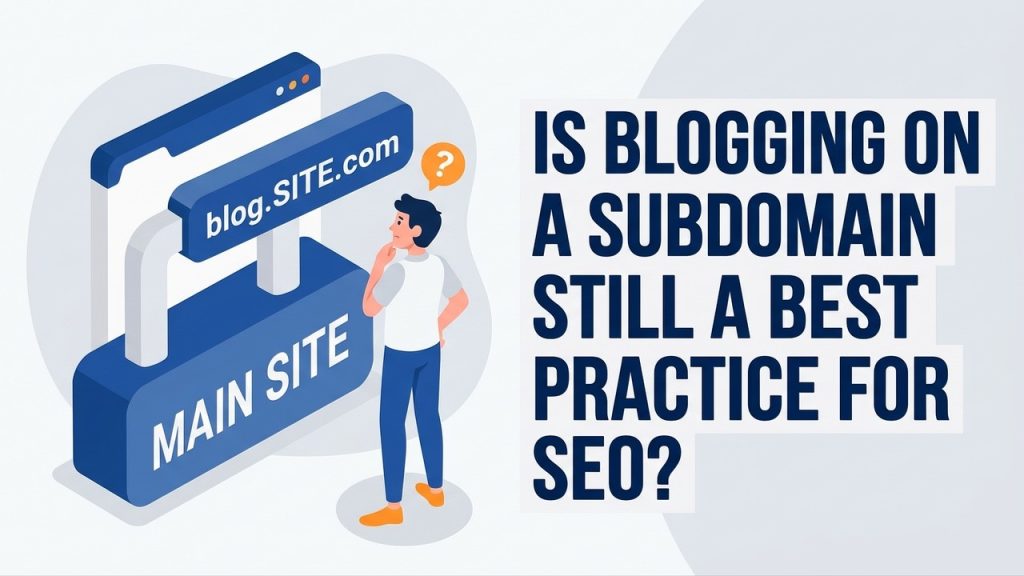
Yes, a blog subdomain can be a good choice, especially when we want to keep blog posts from competing with the main pages on our website. We can also publish on separate sites or platforms under our brand. The goal is simple: protect the pages that need to rank and turn search traffic into business.
That does not mean every blog on a main website is a mistake. It means we need to know what we are doing. Adding more posts is not always the answer to weak SEO results. Sometimes, too much content is part of the problem.
Give the Main Website a Clear Job
Our main website has a purpose. For a local business, that often means helping people find the right service or location page and take the next step. Those pages have a conversion goal. We want them to bring in business, not just attract visits.
A blog has a different role. It gives us space to explain topics, answer questions, and publish supporting content. Trouble starts when our blog posts cover the same ground as our main pages without a clear reason.
If we keep adding pages about the same service, we may end up with several pages trying to do one job. Instead of supporting the page we want to rank, those posts can become competing pages.
Before we decide where to put a blog, we need to decide which pages matter most. The site structure should support those pages, not crowd them with more versions of the same topic.
The “More Content” Habit Can Work Against Us
We have all seen the same response to an SEO campaign that is not doing well: add more pages and put more words on the pages we already have.
A keyword is not ranking? Fine. We publish 16 blog posts that target small changes to that keyword. Surely one of them will do the trick.
But that is not a sound plan by itself. More content does not automatically make a website stronger. If those posts cover closely related topics, we may have created more competition inside our own site.
That is the trap. We think we are filling a content gap, but we may be repeating a topic that already has a page.
Before we add another post, we should ask:
- Do we already have a page that covers this topic?
- Does the new post have a different purpose?
- Are we helping our main page, or creating another page that targets the same thing?
- Are we publishing because the content is needed, or because rankings are weak?
The last question matters. A weak result is a reason to review our approach, not an automatic order to write more.
Got SEO Questions? Get answers every week at 4pm ET at Hump Day Hangouts. Ask questions ahead of time, or live – just go to: https://semanticmastery.com/hdho (bookmark this!) 10+ years of insights given every week!
Get your checklist to help get better results with GBPs, faster.
Need DFY services for you Local SEO projects? Head over to Semantic Links.
Competing Pages Are the Problem to Look For
Keyword cannibalization gets a lot of attention in SEO. It can happen, but the more common issue we are talking about here is competing pages.
We do not need to get stuck on the label. The practical concern is that we have several pages on the main site covering much the same subject. Those pages may be working against the page we actually want to perform.
They do not have to use the exact same words. We can write each post from scratch and still create overlap. Changing a headline or targeting a slightly different keyword does not always give a page a different job.
That is why “the content is original” is not enough. We also need to ask whether it belongs on the main site.
Fresh wording and a clear purpose are two different things. We want each main-site page to have a reason to exist beyond being another attempt at the same search term.
Why a Blog Subdomain Can Be a Cleaner Choice
A subdomain gives us a separate place for ongoing blog content. Rather than placing every new post within the main website, we keep the blog apart from the core pages.
That separation is the reason we recommend it in this situation. We can keep publishing without adding more closely related pages to the main site.
The blog posts may still overlap with one another. Moving them does not make every content choice perfect. But the main concern here is protecting the top-level pages that have a conversion goal.
We want our main site to stay focused. The blog can carry the ongoing flow of supporting content without turning the main website into a pile of posts about the same few services.
This is not a claim that a subdomain fixes every SEO issue. It is a way to separate two jobs: the main site handles the pages we want to rank and convert, while the blog gives us room to publish.
Separate Branded Properties Are Another Option
A subdomain is not the only place we can put blog content. We can also use separate branded properties outside the main website.
The idea is the same. We keep our ongoing publishing away from the core site so that we are not adding competing pages there.
For this decision, the key question is where the content sits in relation to our main pages. We do not need every article to live on the main website just because it belongs to our brand.
We also should not turn that advice into a blanket rule about duplicate content across the web. The issue we are addressing is narrower: too many similar pages within the site whose main pages we want to protect.
Whether we choose a blog subdomain or another branded property, we should know why we are using it. More places to publish are useful only when they serve a clear content plan.
What If We Already Have Too Many Blog Posts?
If our site is underperforming, we should not assume it needs another batch of articles. First, we need to look at what we have already published.
Have we kept writing about the same service? Have we built posts around every small keyword change? Does one main page now have several blog posts covering much the same ground?
If so, overproduction may be part of the problem. The next step is to stop adding to that overlap while we review the site.
A simple review can help us see the pattern:
- Identify the conversion pages. Decide which service or location pages we want to perform.
- Check the related posts. Look for content that repeats those pages’ topics.
- Review each page’s purpose. Ask whether it does a separate job.
- Choose a home for future posts. Consider a subdomain or separate branded property for ongoing publishing.
This is not a call to delete every blog post. It is a call to stop treating content volume as the answer to every ranking problem.
Protect the Pages That Bring in Business
Blogging on the main website can work when we have a clear plan. But when our default response to weak rankings is more posts on the same topics, we can create problems for ourselves.
We can keep publishing. We can keep answering questions and building supporting content. We just need to be more careful about where that content goes.
Our goal is not to build the biggest website. Our goal is to help the right pages perform. A blog subdomain or separate branded property can give us room to publish while keeping the main site focused on that job.