
When people talk about local SEO citations, most of the conversation stays on the easy stuff. Big business directories. Bulk submission tools. Fast setup. Clean reports.
That is fine as far as it goes. But it also misses where some of the best local SEO wins come from.
The strongest citation opportunities are often the ones that are hardest to get. They take more research. They take more work. And they usually cannot be pushed out with a one click system.
If we want better local rankings, better local signals, and a stronger fit between a business and its market, we have to look past the easy directory list.
Table of Contents
Why generic citation services only go so far
Services like Yext and similar tools can help with the major directories. That part still matters. We should not ignore the big, trusted business listings.
But there is a reason so many citation services all seem to use the same websites. Those sites are easy to automate.
That means:
- They are easy to submit to
- They are easy to scale
- They are used by almost everyone
- They tend to create the same footprint across many campaigns
So yes, those citations have a place. But no, they are not usually where the real edge comes from.
The real edge often comes from citations tied closely to a city, county, neighborhood, trade, or business category.
What Citation Sniper focuses on
Instead of trying to force a full automated citation building system, the current focus is on citation research and scraping.
That means gathering the sources that are most relevant for a business, then handing over the data needed to decide which opportunities to pursue.
There are two main types of scraping involved:
1. Location based scraping
This looks for hyper local citation sources. These are listings and directories connected to a specific place.
Examples can include:
- Local directories
- Town or city business listings
- Regional community sites
- Chamber or area association sites
These help build geographic relevance. In plain terms, they make it clearer that a business belongs in that local area.
2. Industry based scraping
This looks for citation sources tied to the business category or niche.
Examples can include:
- Trade directories
- Industry associations
- Niche business listings
- Category specific publications or databases
These help build topical relevance. They connect the business to what it actually does.
That mix matters. A local plumbing company, tree service, law office, or contractor does better when its citations show both where it works and what kind of work it does.
Got SEO Questions? Get answers every week at 4pm ET at Hump Day Hangouts. Ask questions ahead of time, or live – just go to: https://semanticmastery.com/hdho (bookmark this!) 10+ years of insights given every week!
Get your checklist to help get better results with GBPs, faster.
Need DFY services for you Local SEO projects? Head over to Semantic Links.
Why submission is still so manual
There was an effort to make the submission side semi automated, but the tech is not quite ready for that at scale.
That is the big difference between broad citation tools and hyper targeted citation work.
The more specific the source, the more likely it is that:
- The form is different
- The registration steps are unique
- A human review is needed
- Extra business details are required
- The listing may be free on one site and paid on another
That makes it hard to turn into a clean, repeatable process for large scale fulfillment.
And honestly, that is part of the point.
If a citation is hard to get, fewer people go after it. If fewer people go after it, it often carries more weight when it is highly relevant.
What comes in the citation report
The scraping output is not just a list of website names. It is built to help us review opportunities fast and make good choices.
The report includes a spreadsheet with detailed data for each citation source. It also includes screenshots of the sign up or registration pages.
That helps with a few things:
- We can quickly see what kind of site it is
- We can check whether the opportunity looks legitimate
- We can spot whether a listing appears to be paid or free
- We can decide which sites are worth the effort
The delivery also includes a zipped folder with the spreadsheet and the screenshot files, so the research is easy to review and sort.
This is a smart approach because not every citation source deserves the same amount of effort. Some are obvious wins. Some are optional. Some may not fit the campaign at all.
Do these citations actually work for local SEO?
Yes. They work very well when they are relevant and used properly.
That has been proven in real local campaigns, including work done for tree service clients over the years. Manually building highly targeted citations has produced strong results.
The problem is not whether they work.
The problem is that they are time heavy.
That is why research matters so much. If we can uncover the right opportunities first, we can spend our effort where it has the best chance to help rankings.
Why hard to get citations often help more
There is a simple pattern in local SEO.
The harder a relevant citation is to get, the more impact it often has.
That does not mean every difficult listing is good. Relevance still comes first.
But if a citation checks these boxes, it is usually much stronger than another generic brand mention on a national directory:
- It is tied to the local service area
- It fits the business category closely
- It is not part of the same recycled list everyone uses
- It takes real effort to secure
Think of it this way. A random listing on another big directory may tell search engines that the business exists. A niche or hyper local citation tells search engines something deeper. It says this business belongs here, and this business is known for this type of service.
Topical relevance and geographic relevance
This is the heart of the strategy.
Hyper local citations build geographic relevance. They reinforce the local area signal.
Industry specific citations build topical relevance. They reinforce the subject or service signal.
Both matter in local SEO.
For example:
- A roofer listed on a city business directory supports local relevance
- A roofer listed on a roofing contractor directory supports topical relevance
- A roofer listed on both creates a stronger overall local profile
This is why citation research should not just be about quantity. Raw citation count is not the whole story.
A smaller set of highly targeted citations can often do more than a much larger batch of weak, generic ones.
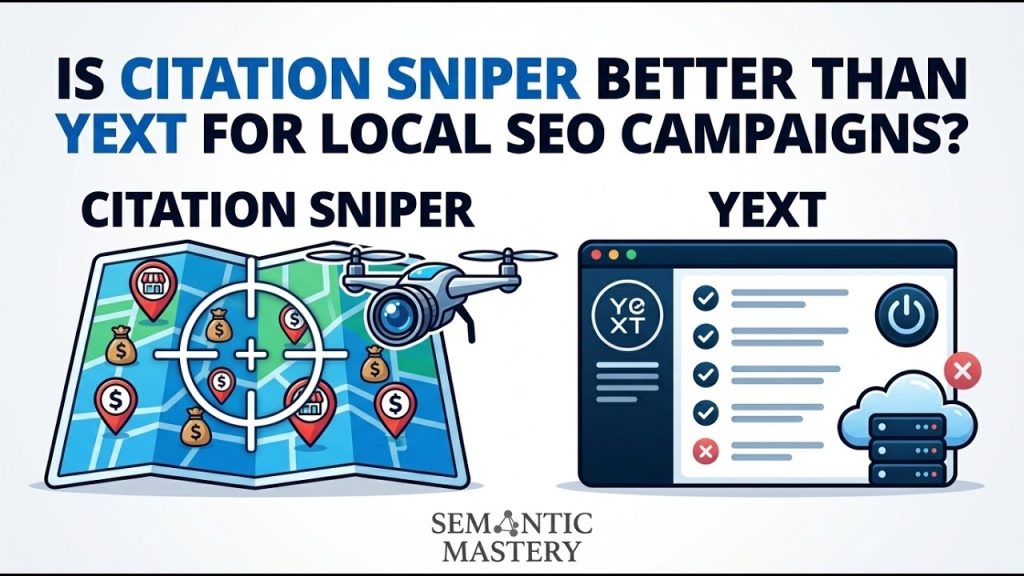
So is Citation Sniper better than Yext?
It depends on what we mean by better.
If we want fast coverage on the common directories, a service like Yext can help with that kind of distribution.
If we want deeper citation opportunities that support stronger local and niche relevance, then focused citation research has a clear advantage.
It is not really an either or choice. The smarter move is usually:
- Get the major directories handled
- Then go after the harder, more relevant citations
Most agencies stop after step one because step one is easy.
Step two is where the extra work starts, and often where better gains are found.
A practical way to use this in local SEO campaigns
If we are building a local SEO campaign, a good process looks something like this:
- Make sure business information is consistent on the major platforms
- Research hyper local citation opportunities in the target area
- Research niche and industry specific directories
- Review each source for fit, cost, and submission effort
- Prioritize the most relevant opportunities first
- Build them manually when needed
If local SEO is a big part of the business model, it helps to use proven systems and checklists. For more support on process and Google Business work, the GMB process checklist and the free Local SEO Toolkit can help organize the work.
For those ready to go deeper into local SEO and agency growth, the MasterMIND is also available.
FAQ
Are general business directories still worth building?
Yes. We should still build citations on the major directories. They are part of a solid local SEO foundation. The problem comes when we stop there and ignore the more relevant local and niche sources.
What makes a citation hyper local?
A hyper local citation is tied closely to a city, neighborhood, county, or service area. It helps show that the business has a strong connection to that place.
What makes an industry specific citation helpful?
It connects the business to its trade or category. That adds topical relevance, which helps search engines better understand what the business does.
Why not automate all citation submissions?
Many niche and local sites have different forms, different rules, and different approval steps. That makes full automation hard. Manual work is still needed for many of the best opportunities.
What is included in the citation research deliverable?
It includes a spreadsheet with citation source data and screenshots of the registration or sign up pages. That makes it easier to review each opportunity and decide what to pursue.
Is Citation Sniper a replacement for Yext?
Not really. They serve different purposes. Broad citation tools help with easy, common listings. Citation research helps uncover the harder opportunities that can add stronger relevance to a local campaign.
Local SEO gets better when we stop chasing easy volume and start looking for fit. The citations that often move rankings are not the ones every tool can submit in bulk. They are the ones connected to the right place and the right topic, even when they take more work to secure.
That is why targeted citation research stands out. It helps us find the listings that are not just available, but actually worth having.