
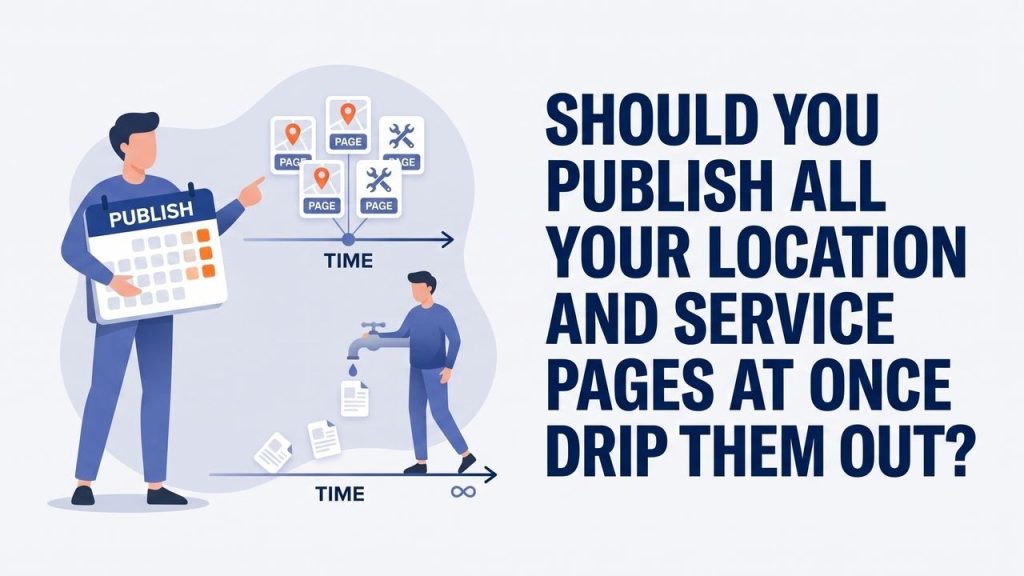
If we have five location pages and 20 service pages finished, our advice is simple: publish them all at once. For a normal local business website, we do not need to hold back completed pages just to spread out the launch.
A drip schedule means we release pages bit by bit over time. That can make sense when we are still writing the content. But when the work is done, we would rather get the site live and focus on helping Google find the pages.
The bigger task is not picking a publish date for each page. It is keeping our sitemaps clean, submitting them through Google Search Console, and making it clear which pages we want Google to crawl and index.
Publish Finished Pages Without an Artificial Delay
For a regular client website or local SEO project, we do not see a reason to drip out pages that are ready to go. A set of five location pages and 20 service pages is not the same as an old mass-page build.
With those older methods, we might have created hundreds or thousands of pages. In that setting, spreading out the release could have made sense. That is not a strategy we recommend now.
For a real business site, we should treat the launch as a normal website project. If the planned pages are complete, we can publish the completed set together.
We do not need to turn 25 finished pages into weeks of scheduled releases just because it feels more careful. Our approach is to get the work live, then move on to discovery and crawling.
Drip Pages When the Content Is Still Being Built
There is one clear reason to publish in stages: we need to launch before every page is finished.
Maybe our location pages are ready, but we are still writing the service pages. We can launch what is complete and add the rest as we finish it. In that case, the pace of the work sets the publishing schedule.
That is different from sitting on finished content. We are not slowing down the launch for an assumed SEO benefit. We are simply publishing at the speed we can complete the pages.
- All planned pages are finished: We publish them together.
- Some pages are still being written: We publish the finished pages and add the rest as they become ready.
- The plan is a mass-page build: We do not use that older approach as the model for a normal local business site.
This keeps the choice simple. Our content workflow should drive a staged launch, not a rule that every site needs a slow rollout.
Got SEO Questions? Get answers every week at 4pm ET at Hump Day Hangouts. Ask questions ahead of time, or live – just go to: https://semanticmastery.com/hdho (bookmark this!) 10+ years of insights given every week!
Get your checklist to help get better results with GBPs, faster.
Need DFY services for you Local SEO projects? Head over to Semantic Links.
After Launch, Submit the Sitemap in Search Console
Once the pages are live, our next step is Google Search Console. We want Google to discover the URLs we have just published.
A sitemap lists URLs on the site. Submitting it gives Google a clear place to find the pages we want it to crawl and consider for its index.
Some sites have a single sitemap. Others use a sitemap index, which points to several separate sitemaps. Those might include a page sitemap, a post sitemap, or a location sitemap.
Our process is to submit the sitemap index when the site has one, then submit the relevant child sitemaps as well. This gives us a direct way to submit each important set of URLs.
We should keep the goal clear, though. Submitting a sitemap helps with discovery; it does not promise that every URL will be indexed. It is a useful launch step, not a guarantee of search results.
Clean Up the Sitemaps Before Submitting Them
We often see sites with far more sitemaps than they need. The sitemap index may include tags, categories, images, page-builder elements, and other items that do not belong in that site’s search plan.
Our preference is to keep things lean. We should submit sitemaps for the pages and posts we actually want Google to crawl and index, rather than pass along every sitemap the site creates.
Depending on the site, the useful set may include:
- A page sitemap for the main website pages, including service pages.
- A post sitemap if the site publishes posts that belong in search.
- A location sitemap if a multi-location site uses one.
Other sitemaps need a reason to be there. We should review tag, category, image, and page-builder sitemaps instead of leaving them in place by default.
The point is not that every extra sitemap is always wrong. The point is that our sitemap setup should serve the site we are building. If a set of URLs does not need to be crawled and indexed, we should leave that set out of the submitted sitemaps.
Keep Local Blog Content From Competing With Core Pages
For local SEO, our preference is to keep blog posts off the main local business site. We would rather place that content on a subdomain or on external branded assets.
The concern is competing pages. When blog content covers the same service topics as the core site pages, we can create overlap between pages that we want to serve different roles.
That is why we do not assume every local site needs a post sitemap. If the site is built around service and location pages, the sitemap should reflect that plan.
This is part of the same cleanup process: we decide which content belongs on the site, which pages matter for search, and which sitemaps support those choices.
Use a Page Speed Test as an Extra Launch Step
For a new domain, we also recommend running the homepage through Google’s page speed test. The test fetches the page to assess it, and we use that as another way to prompt Google to access the new site.
We can do the same for a few other important pages. It is an extra step to try, not a replacement for sitemap submission or a promise of faster indexing.
There is also a time cost. A test can take roughly 30 to 45 seconds, so running one for every page can become tedious. Our approach is to start with the homepage and use it selectively on a handful of other pages.
Our Simple Local SEO Launch Checklist
For a site with five finished location pages and 20 finished service pages, we would follow this order:
- Publish the completed pages together.
- Review the sitemap index and its child sitemaps.
- Remove sitemap entries or groups that do not fit the site’s indexing goals.
- Submit the sitemap index and relevant individual sitemaps in Google Search Console.
- Run the homepage through Google’s page speed test, with a few other key pages if useful.
Finished pages do not need an artificial waiting period. If the content is ready, we publish it. If it is still being built, we release it as it is finished. Then we put our effort into a clean site structure and clear paths for Google to find the pages that matter.