
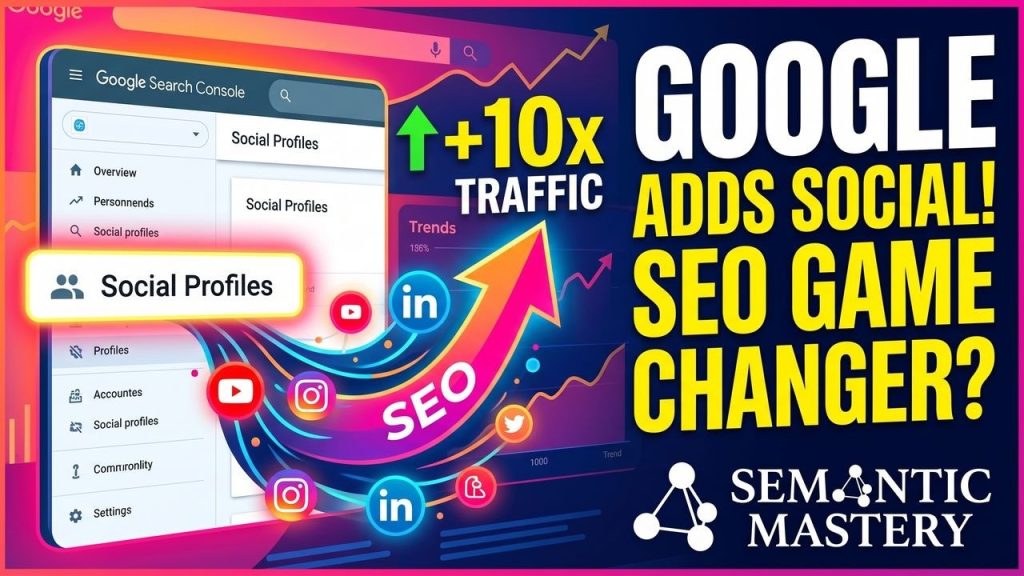
Google has added the option to connect social media profiles to Google Search Console. It is a small feature on the surface, but it points to a much bigger SEO idea: Google is getting better at connecting brands, people, websites, and online profiles.
If we can give Google more clear proof that a business is real, active, and connected across the web, we should generally do it. Connecting a business’s social profiles to Search Console is one more way to support that connection.
Table of Contents
Connect Social Profiles to Strengthen Brand Signals
We would connect social media profiles to Google Search Console, especially for businesses that are active on social media. This is even more useful when we are regularly publishing content for a client or helping them maintain an active presence.
The point is not that adding a Facebook, LinkedIn, or other social profile will suddenly push a website to the top of Google. SEO rarely works that way. Instead, it gives Google more supporting assets tied to the same brand.
Think of it as adding more evidence. A website, Google Business Profile, social media profile, business name, and real people connected to the company can all help Google better understand the entity behind the content.
When the details line up across those places, we make it easier for Google to see:
- Who the business is
- What services it provides
- Who represents the business
- Which profiles and assets belong to the same company
- Whether the business has a consistent presence online
We can already add social profile links to a Google Business Profile. Adding those profiles to Search Console makes sense for the same reason. It helps build a stronger connection between the branded assets in the Google ecosystem.
Social Media Is Not Always a Lead Source for Local Businesses
We should be realistic about what social media does for many local service businesses. In industries such as tree service, home services, and construction, social media often does not create a steady stream of direct leads.
That does not mean social media has no use. It means we should not sell it as something it is not.
For many local business clients, we do not provide full social media management. Full management includes replying to comments, joining conversations, responding to messages, and handling daily engagement. That work needs to be done by the business owner or their team.
What we may do is publish content on their behalf. The client remains responsible for responding when someone comments, asks a question, or reaches out through the platform.
This approach keeps the work focused. Instead of pretending social media is a magic lead machine, we use it to support authority, visibility, and the business’s broader online presence.
Got SEO Questions? Get answers every week at 4pm ET at Hump Day Hangouts. Ask questions ahead of time, or live – just go to: https://semanticmastery.com/hdho (bookmark this!) 10+ years of insights given every week!
Get your checklist to help get better results with GBPs, faster.
Need DFY services for you Local SEO projects? Head over to Semantic Links.
Why Personal Profiles Can Work Better Than Branded Posts
One of the more interesting ways to use social media for local SEO is to publish through a real person’s profile, not only the company’s branded profile.
For example, in the tree service industry, the owner is often a certified arborist. That person has real experience and can speak with authority about tree trimming, tree removal, disease treatment, pest issues, and general tree care.
Rather than publishing only generic company updates, we can build up that person’s profile as a local subject matter expert.
We are not saying every business owner needs to become a famous industry expert. They simply need to show real knowledge in their local market. A certified arborist discussing the tree problems they see in their community is far more believable than a faceless business page posting broad tips that could apply anywhere.
This also helps when publishing content on the company website. Content tends to perform better when it has authorship assigned to a real, verifiable person with relevant expertise.
There is a noticeable difference between these two approaches:
- Generic branded content: A company publishes an article with no named author and no clear expert behind it.
- Expert-led content: A real business owner or employee is listed as the author and has an active profile that supports their expertise.
The second approach gives search engines more context. It helps connect the content to a person who has a reason to speak about the topic.
AI Content Needs Real Expertise Behind It
AI has made it much easier to create articles, service pages, posts, and other content at scale. The problem is that everyone can now create more content, and much of it sounds very similar.
When hundreds of pages answer the same question in nearly the same way, Google has to decide which ones deserve visibility. We can think of this as an AI suppression filter. Content may not perform well simply because it is too close to everything else already published.
We can improve the odds by adding signals that generic AI content cannot easily copy.
Assign Content to a Verifiable Expert
First, assign authorship to a real subject matter expert. The author should have a clear connection to the business and should be knowledgeable about the topic.
For a tree service company, that may be the owner, a certified arborist, or another experienced team member. For another local business, it could be the person who actually performs the work and understands the customer problems firsthand.
It is even better when that person is active on social media. Their social profiles, posts, business connection, and website authorship can all reinforce the same identity.
Add Stories AI Cannot Make Up
Second, add real experiences from the business. This is where the content becomes more useful and more believable.
We can get these details by having a simple conversation with the business owner. Ask them about things that happened on job sites, unusual customer situations, local conditions, mistakes they have seen, funny moments, difficult projects, or lessons learned over many years.
These details do not need to be dramatic. They just need to be true and specific.
A tree care article becomes much stronger when it includes a real example of a disease pattern found in a local neighborhood, a storm-related issue the team regularly sees, or a common mistake homeowners make before calling an arborist.
That kind of insight adds a human angle that AI cannot produce on its own. AI can organize and help draft content, but it does not have personal job-site experience. It has not spoken with the customer, seen the damaged tree, or solved the problem.
The strongest approach can combine both methods:
- Use AI to help create and organize content
- Assign authorship to a real expert
- Include stories, opinions, and insights from that expert
- Support the author’s identity with active social profiles
This helps content stand apart from the growing pile of generic pages built from the same basic information.
What Search Console May Show From Social Profiles
It is important to set the right expectation for this new Search Console feature. Google Search Console is not a full social media analytics tool. It is not designed to show every like, comment, share, or platform-level engagement metric.
Search Console is focused on Google Search activity. The useful data may be related to search queries, impressions, and clicks coming from Google Search to connected social profiles.
That could help us learn more about how people find both a business and the people connected to it. For example, we may be able to see whether branded searches or searches related to an expert’s name lead to a social profile through Google.
For businesses where we publish through personal profiles, it will be especially interesting to compare the results. We can look for signals tied to the company name, the owner’s name, and services connected to their expertise.
A Simple Action Plan for Local SEO
If a business is active on social media, or if we are helping make it active, connecting those profiles to Search Console is worth testing.
- Confirm that the social profiles are legitimate and represent the real business or expert.
- Make sure the business name, website, services, and contact details are consistent across major profiles.
- Connect relevant social profiles to Google Business Profile where appropriate.
- Add the available social profiles to Google Search Console.
- Publish useful content under the name of a real subject matter expert.
- Collect true stories and local insights from the business owner to make content less generic.
- Review Search Console data over time for brand, service, and personal-name search activity.
We should not treat this as a one-click SEO fix. It is part of a larger strategy built around entity validation, clear authorship, and authentic expertise.
As AI makes basic content easier to create, the businesses that stand out will be the ones that prove there are real people behind the pages. Strong social connections, real expert authors, and first-hand stories give Google much better reasons to trust and surface that content.
Frequently Asked Questions
Should we connect social media profiles to Google Search Console?
Yes, especially when the business or its representatives are active on social media. It can help Google connect supporting brand assets and better understand the business entity.
Will connecting social profiles directly improve rankings?
We should not expect an instant ranking boost. The benefit is more about giving Google clearer supporting information about the brand, its people, and its online presence.
Why does authorship matter for AI-generated content?
AI content can become repetitive because many pages cover the same topics in similar ways. Assigning content to a real expert and adding their true experiences makes the page more distinct and more credible.
Do local businesses need full social media management?
Not always. In many home service industries, social media may not produce many direct leads. Publishing expert content can still support authority, branding, and SEO, while the business handles replies and customer engagement.