
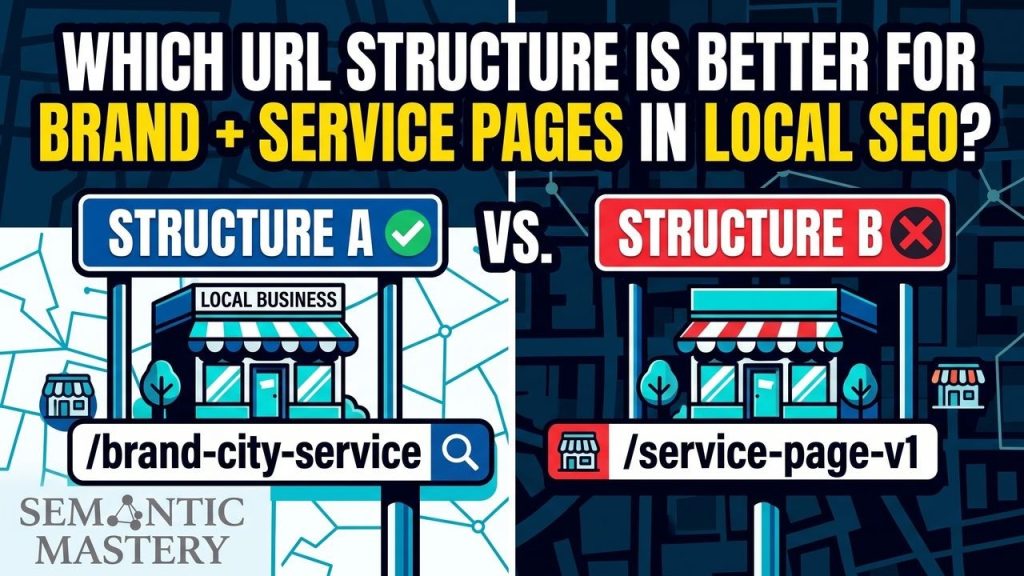
When we build a local SEO website, the URL structure can either help the site grow or make it harder to rank. This is especially true for businesses that offer several services, serve several cities, and work with known product brands.
A locksmith is a great example. The business may offer lock installation, lock repair, car lockout help, and 24-hour service. It may also work with brands such as Schlage and Medeco. The big question is whether we should build pages around services first or brands first.
Our answer is simple: do not create a separate page for every possible mix of service, brand, and city. Build a clean site with one clear page for each main topic, then connect those topics with smart internal links.
Table of Contents
The Two URL Structure Options
A service-first setup may look like this:
In this structure, the service is the main category. The brand is a smaller page beneath it.
A brand-first setup flips that order:
Here, each brand has its own hub, with service pages below it.
Both ideas have logic behind them. The service-first model puts more focus on the service. The brand-first model tries to build a strong connection with the manufacturer. But neither structure is the best answer if it creates a large number of overlapping pages.
Got SEO Questions? Get answers every week at 4pm ET at Hump Day Hangouts. Ask questions ahead of time, or live – just go to: https://semanticmastery.com/hdho (bookmark this!) 10+ years of insights given every week!
Get your checklist to help get better results with GBPs, faster.
Need DFY services for you Local SEO projects? Head over to Semantic Links.
Why Service and City Pages Often Cause Problems
Many local sites used to follow an old pattern: create one page for every service in every city.
For example, imagine a locksmith with five services and ten target cities. That can lead to 50 pages:
- Lock installation in City One
- Lock installation in City Two
- Lock repair in City One
- Lock repair in City Two
- And so on for every service and location
This sounds thorough, but it often creates a bloated website. Each city ends up with nearly the same service content. The site repeats itself over and over.
That repetition can create competing pages. This happens when more than one page on the same site could answer the same search. Google may show several of those pages in search results, but it may not push any one of them near the top.
That is different from full keyword cannibalization, which is usually more severe. Still, competing pages can hold rankings back. Instead of giving Google one strong answer, we give it several similar answers and make it choose.
Site Efficiency: Say It Once, Say It Well
Two things matter a great deal in local search:
- Branded location authority
- Site efficiency
Site efficiency means making the site easy for search bots and AI systems to crawl and understand. A clean site has less waste, less repeat content, and fewer pages competing for the same searches.
We do not need to repeat the same information on dozens of pages. We only need to say it once, say it well, and then use internal links to show how that topic connects to other parts of the site.
For a locksmith, that means creating:
- One page for each service
- One page for each city or town served
- One page for each brand, when brand searches make sense for the business
This approach gives every page a clear job. The service page explains the service. The location page explains the area. The brand page explains the brand relationship. Then internal links join them together.
Should We Lead With Services or Brands?
For most locksmith businesses, we would normally lead with services. People who are locked out of a car or need a damaged lock fixed are more likely to search for a service than a lock manufacturer.
Common searches may include:
- Locksmith plus city name
- 24-hour locksmith plus city name
- Car lockout service plus city name
- Lock repair plus city name
- Lock installation plus city name
That is why a service-focused keyword strategy will often reach a wider group of local customers. However, we should research the actual search demand before building. In some industries, people do search by product brand. If that happens, brand pages can help us capture those searches.
The important point is that branded location authority usually refers to the business’s own brand in its local market. It does not automatically mean we should build the entire site around the brands of products the business works with.
How to Connect Services, Brands, and Locations
Internal linking is how we create strong relationships without making duplicate pages. We can connect all three topics, service, brand, and location, from the pages we already have.
On each service page
A lock repair page should focus on lock repair. Then we can add an H2 heading such as Lock Brands We Service. Under that heading, we can list H3-linked brand names, such as Schlage and Medeco, each pointing to its own brand page.
Next, we can add another H2 such as Areas We Serve for Lock Repair. Under it, link the cities and towns where the business provides lock repair.
Now that one service page clearly connects lock repair with the relevant brands and locations.
On each brand page
A Schlage page should explain the business’s work with Schlage locks. It can include an H2 for the Schlage-related services offered, with links to lock installation, lock repair, or other relevant service pages.
It can also include an H2 for the service areas where Schlage work is available. Those links point to the location pages.
On each location page
The city page should focus on that city or town. It can include sections that link to:
- The services offered in that area
- The lock brands the business works with
This creates clear associations in every direction. A service points to matching brands and places. A brand points to matching services and places. A location points to matching services and brands.
We get a well-connected site without needing a page for “Schlage lock repair in City One,” another for “Schlage lock repair in City Two,” and dozens more like them.
Simple Silo vs. Complex Silo Architecture
We generally want to keep pages close to the homepage. A simple silo structure is often only two levels deep. For example:
- domain.com/lock-repair/
- domain.com/city-name/
- domain.com/schlage/
Simple structures often perform well because internal link equity can move to key pages more easily. The deeper a page sits in the URL structure, the less internal link equity it may receive.
A complex silo has three or more levels. Sometimes that is the right choice, especially for a large multi-location business that covers a wide region or works across state lines. In those cases, the site may need a clear geographic order, such as state, region, city, and then local details.
The point is not that complex silos are bad. The point is that we should not add depth unless the business truly needs it.
Plan for Growth Before Building
If a business may expand into more cities later, we should plan for that from the start. We need to know the likely size of the service area, whether it may cross state lines, and whether the goal is local, regional, or national growth.
It is much easier to build a site for future growth upfront than to rebuild the whole architecture later. Changing a simple site into a complex silo after hundreds of pages are live can become a difficult job.
Even if the business does not expand as planned, a well-thought-out structure gives us room to grow without creating a mess.
Best Practice for Local SEO Site Structure
For a locksmith and many other service-area businesses, we would start with a clean, topic-based structure:
- One page per service, such as lock installation, lock repair, lockout service, and 24-hour locksmith help.
- One page per target location, such as each city or town in the service area.
- One page per relevant brand, such as Schlage or Medeco, if brand demand supports it.
- Clear internal links that connect each service, brand, and location where they are relevant.
This keeps the site lean, reduces competing page risk, and helps search engines understand exactly what the business does, which brands it handles, and where it operates.
Do not build more pages just because we can. Build the pages that need to exist, make each one strong, and use internal links to create the connections.
Frequently Asked Questions
Should we create a page for every service in every city?
Usually, no. That approach can create many similar pages that compete with each other. One strong service page and one strong location page, connected with internal links, is often a cleaner choice.
Should a local business use service-first or brand-first pages?
We would usually lead with services when people are more likely to search for the service itself. Brand pages can still be useful when customers search for specific manufacturers.
What are competing pages in SEO?
Competing pages are two or more pages on the same site that are relevant to the same search. Google may spread impressions across them instead of ranking one strong page higher.
When should we use a complex silo structure?
A complex silo can make sense for a business with a large service area, multiple regions, or locations across state lines. For a smaller local business, a simpler structure is often easier to manage and understand.