
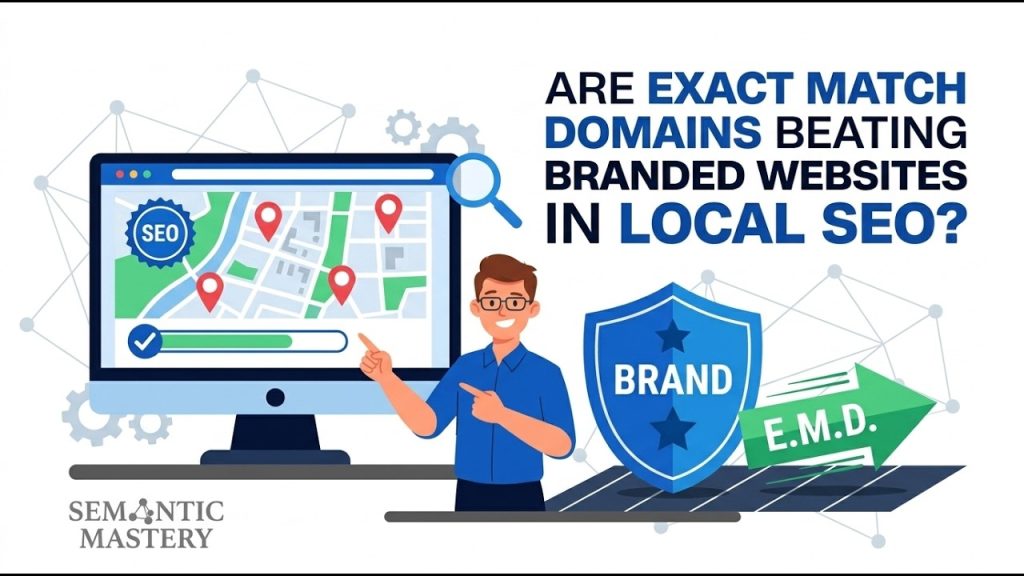
Right now, exact match domains are doing very well in local SEO. In a lot of markets, they look like a shortcut. You search for a service plus a city, and there they are. You check the map pack, and exact match business names are showing up there too.
So it is fair to ask the big question: should we still build a real brand, or should we chase what seems to be working today?
Our answer is simple. Build the brand.
Exact match spam may work today. It may even work for a while. But strong branding is the safer long-term move, and for local businesses, long-term matters more than short-term tricks.
Table of Contents
Exact match domains are working, but that does not make them smart
We should be honest about what is happening. Exact match domains have been performing very well in local search. In some cases, they are acting like a cheat code. That part is real.
The problem is that search results change. Google shifts all the time. What looks strong this month can disappear fast. A tactic that seems unbeatable now might be ignored later, or worse, become a liability.
That is why we should not rush out and build a whole strategy around exact match spam.
When we lean too hard on tricks, we build on rented ground. We do not control the rules. Google does. If those rules change, the business can get hit overnight.
A brand, on the other hand, keeps building value over time.
Why branding is still the right move
A strong brand is evergreen. That means it keeps helping no matter how search engines shift.
When people in a local market know a business by name, the business becomes less dependent on generic keyword rankings. Instead of hoping to rank for “roof repair Dallas” or “plumber Tampa,” the goal becomes getting people to search for the company itself.
That is a much better place to be.
If customers ask for a business by name, the company is harder to replace. It is not just another listing in search results. It becomes the known option. The trusted option.
This is why modern SEO should focus more on associations than hacks. We want search engines to clearly connect three things:
- The brand
- The services or products the business offers
- The locations the business serves
That is the real job now. We are teaching the algorithms what the business is, what it does, and where it does it.
That approach holds up much better than spam.
Got SEO Questions? Get answers every week at 4pm ET at Hump Day Hangouts. Ask questions ahead of time, or live – just go to: https://semanticmastery.com/hdho (bookmark this!) 10+ years of insights given every week!
Get your checklist to help get better results with GBPs, faster.
Need DFY services for you Local SEO projects? Head over to Semantic Links.
The hidden cost of exact match spam
The biggest danger is not that spam fails. The biggest danger is that it can damage the brand while it works.
If we spam a Google Business Profile, force exact match naming, or push weak signals that do not match reality, we may get a bump for a while. But we are also feeding search engines bad data about the business.
When that tactic stops working, we are left with a weaker brand footprint and a mess to clean up.
That is not a good trade.
We should build around truth. Real brand signals. Real service connections. Real location relevance. That gives us a stronger base, both for search engines and for the local market itself.
Local businesses cannot rely only on SEO anymore
This is the bigger issue, and honestly, it matters more than the exact match domain question.
Even local businesses that rank well are seeing fewer leads from search. Search behavior is changing. The way people find services is changing. The amount of trust placed in standard search results is shifting too.
So if a local business puts all of its lead generation into Google rankings, that is risky.
Very risky.
SEO still matters. We are not saying to stop doing SEO. Not at all. But relying on search marketing alone is a bad plan now. For many businesses, it is only a matter of time before that becomes a serious problem.
That means agencies and consultants need to adapt too. If we only offer rankings, we are tying our own future to a channel that is getting less predictable.
What to do instead: build more than one lead source
The better play is to keep doing local SEO while adding other ways to bring in leads.
That includes going back to some classic marketing methods that have worked for a very long time, such as:
- Direct response marketing
- Direct mail
- Local offline advertising
- Radio ads
- Brand awareness campaigns
- Guerrilla marketing methods
These are not outdated ideas. They are timeless. What changes is how we improve them with modern tools.
And this is where AI becomes helpful.
How AI can support direct response marketing
AI makes it much easier to create focused marketing campaigns around real customer problems.
One strong example is using simple PDF reports as lead magnets. These reports should not be broad or generic. Each one should speak to one painful problem that people care about.
Think of them like small baited hooks. Each report targets one complaint, one fear, or one frustrating issue tied to a service.
For example, people may be upset about:
- Bad service quality
- High prices
- Slow delivery or response times
- Past poor experiences
- Confusing pricing or hidden fees
When we create a report around one of those issues, we can position the local business as the better answer. We can show how that company solves the problem in a clearer, faster, or more reliable way.
That is much stronger than trying to rank for a broad search phrase and hoping for the best.
Find the pain points people already talk about
One of the smartest uses of AI is research. We can now look at public conversations online and quickly spot what people are complaining about in a given industry.
Those conversations happen all over the place, including:
- Social media
- Quora
- X
- Forums and review spaces
From there, we can identify patterns. What keeps coming up? What annoys customers most? What causes them to switch providers? What made them feel burned before?
Once we know that, we can build very specific marketing around it.
That means better lead magnets, better ads, better landing pages, and better offers.
Instead of aiming at generic traffic, we speak to a buyer at the exact moment they care most.
Target buyer personas, not just keywords
This is where local marketing gets more effective.
Rather than chasing broad local SEO terms, we can create campaigns for specific types of buyers with specific problems. We can speak to their concerns in plain language and show why our client is the better option.
That message can then be used across multiple channels:
- Print mailers
- Local ad campaigns
- Landing pages
- Community promotions
- Branded content offers
This kind of targeting often reaches people closer to the point of conversion. They are not just browsing. They are looking for relief from a problem.
That is a much better place to meet them.
SEO still matters, but it should support the brand
The goal is not to abandon local SEO. The goal is to stop treating it like the only answer.
We should still optimize websites. We should still improve Google Business Profiles. We should still work on local authority, links, content, and location relevance.
But all of that should support a bigger goal:
Make the business known, trusted, and easy to connect with in its local market.
If we keep that as the center, our strategy becomes much stronger. Rankings become one part of growth, not the whole plan.
If you want a starting point for local SEO systems, the Local SEO Toolkit and the GMB Process Checklist can help organize the basics.
And if the goal is to build broader local marketing systems beyond just rankings, the MasterMIND is where deeper training fits.
The smarter long-term play
Exact match domains may be winning some local SEO battles right now. That does not mean they are the right foundation for a real business.
Shortcuts come and go. Brand equity stays.
So the smarter move is this:
- Keep doing SEO
- Build strong brand signals
- Create clear associations between brand, service, and location
- Diversify lead sources
- Use AI to create focused direct response campaigns
- Speak to real customer pain points
That path is more stable. It is more honest. And it gives local businesses a better chance to grow without being wiped out by the next search update.
FAQ
Should we buy exact match domains for local SEO right now?
Not as the core strategy. They may help in some markets today, but they are not a stable long-term foundation. A strong brand is safer and more durable.
Are exact match domains still working in Google?
Yes, in many local search results they are performing well. But nobody knows how long that will last. Google can shift at any time.
What should local businesses focus on instead of spam?
Focus on brand building, clear service and location relevance, and more than one lead source. SEO should support the business, not carry the whole business alone.
Why is relying only on SEO dangerous now?
Because even businesses with good rankings are seeing lead volume drop. Search behavior is changing, so depending on Google alone creates a lot of risk.
How can AI help local marketing outside of SEO?
AI can help find customer complaints, research market sentiment, create targeted PDF reports, and build direct response campaigns that speak to specific buyer problems.