
Most contractors want to rank everywhere. That makes sense. If they serve a 30 mile or 50 mile area, they expect Google to show them in all of it.
But that is not how local SEO works anymore.
When we talk to service businesses about Google Business Profile rankings, the best move is not to sell a big dream. It is to be honest. If we promise reach that Google is not likely to give, we set the client up for disappointment and we hurt our own reputation.
That is why we explain proximity in plain language. We keep it simple, direct, and tied to results.
Table of Contents
Start with the area around the business
The first question we ask is simple: Are you already dominating the area where your business is actually located?
If the answer is no, then ranking far outside that area should not be the first goal.
A Google Business Profile is heavily shaped by:
- Proximity to the searcher
- Competition in the market
- Population density
- How crowded the service category is
So even if a contractor serves a big region, Google may only give strong map visibility close to the business address.
That is not a failure. That is the system.
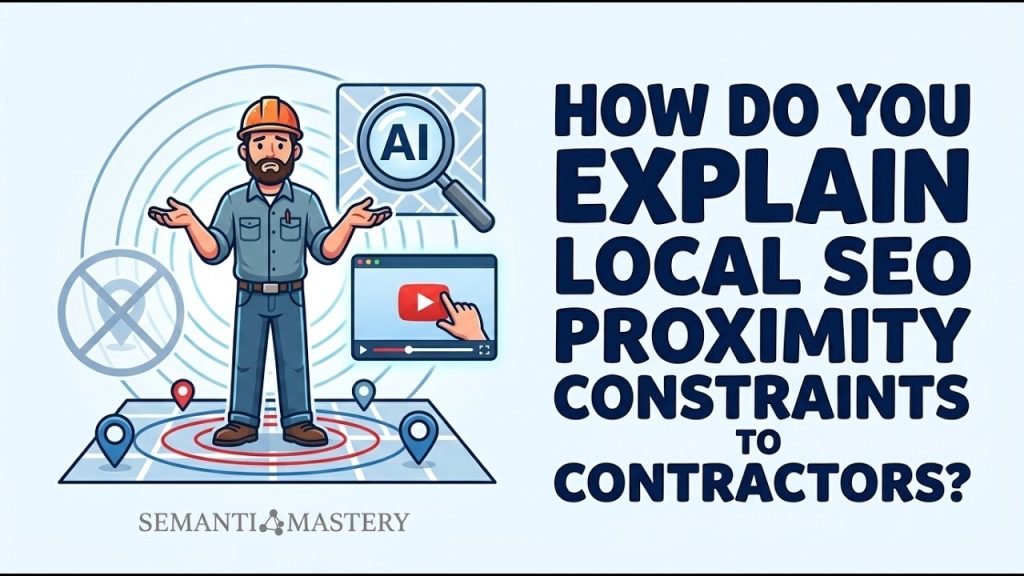
Use the bullseye picture
A simple way to explain this is with a target.
The business location is the center of the target. That bullseye is where we start. From there, we work outward ring by ring and try to expand the area where the Google Business Profile ranks in the map pack.
This picture helps contractors understand the plan fast.
We are not telling them no. We are telling them the order of attack:
- Own the closest area first
- Push the ranking radius outward over time
- Measure where growth slows down
- Use other methods beyond that point
That makes the strategy feel real instead of vague.
Got SEO Questions? Get answers every week at 4pm ET at Hump Day Hangouts. Ask questions ahead of time, or live – just go to: https://semanticmastery.com/hdho (bookmark this!) 10+ years of insights given every week!
Get your checklist to help get better results with GBPs, faster.
Need DFY services for you Local SEO projects? Head over to Semantic Links.
Set range expectations without making promises
Contractors usually ask the next question right away: how far can we rank?
The honest answer is that we cannot know the exact boundary before we start. We can give a rough range based on the market, but not a guarantee.
In many cases, a rough guide looks like this:
- Dense metro area: maybe around 5 miles
- Suburban area: often around 10 miles
- Rural market: sometimes 20 to 30 miles
Those are not fixed rules. They are just realistic starting points.
What matters most is managing expectations. We want to underpromise and then do better if the market allows it.
The invisible boundary every GBP runs into
As we push outward, most Google Business Profiles hit a boundary. We can think of it as an invisible wall.
Sometimes we can force rankings a little beyond that line for a while. But if Google keeps pulling the profile back down, that is usually a sign we are outside the area where the listing can hold strong on its own.
When we see little or no growth after steady effort for a couple of months, that usually means we found the edge.
At that point, it makes no sense to keep throwing time and budget at the same fight.
How photos can help expand local reach
One of the best ways contractors can help is by taking real photos while working in their service areas and uploading them to their Google Business Profile.
This works because those image files often carry location data. That gives Google more proof that the company really works in those places.
When contractors do this well, we can often support wider map visibility than normal.
Not everyone does it. The ones who do tend to get better results.
We can also publish local Google Business posts tied to specific services and places. Even though some image data gets stripped in the posting process, using real jobsite photos still helps support the overall local story.
The message to the contractor is simple: if we want Google to trust your service area, we need real signals from that service area.
What to do when the GBP cannot go farther
Once the profile reaches its map ranking limit, there are really only a few good options left.
1. Run ads outside the coverage area
If the Google Business Profile cannot show strongly in a city farther away, paid visibility can fill the gap.
For many home service categories, that means:
- Local Service Ads
- Google Search Ads
- Map ads with location extensions
These paid placements now take up a huge part of the search results. In many local searches, ads come first, then more ads, then map ads, and only later do unpaid results appear.
That shift matters. Organic rankings still have a role, but they are not the lead machine they once were for many local businesses.
If a contractor wants leads from outside the normal GBP range, ads are often the fastest path.
2. Open another real location
A second Google Business Profile can work, but only if it is tied to a legitimate business location.
That part is harder now than it used to be.
If a contractor has a true office, yard, or another valid setup in a nearby market, there may be a path. In some cases, using a real employee location may be possible, but it still has to be done carefully and within Google’s rules.
This is not something we should pitch casually. It needs to be real.
3. Keep building content for AI search and brand discovery
Even if a GBP does not rank in a distant area, content can still help the business get found.
That matters more now because people are changing how they search.
Many start with AI tools and ask longer, natural questions like:
- Who is the best tree removal company near this town?
- What is the top rated plumber in this area?
- Can you recommend a reliable HVAC company nearby?
If our brand is mentioned across the web and our content clearly ties our services to those places, AI systems can include the company in their suggestions.
Then people often go to Google and search for the business by name.
So content marketing still matters, even when map rankings stop at a hard edge.
If you want tools for prospecting, GBP work, and local SEO systems, the Local SEO Toolkit is worth checking out. For a more detailed checklist, the GMB process guide can also help.
Why honesty closes more deals than hype
The selling part is easier than most people think.
We do not need hard pressure. We do not need big claims. We do not need to act like every call must close today.
What works best is education.
When we explain proximity, competition, and market limits clearly, most contractors get it quickly. Many have already been burned by agencies that overpromised. So straight talk stands out.
That means we can keep the sales call simple:
- Ask about their business
- Review how they are doing now
- Explain what Google will likely allow
- Recommend the best next move
- Leave the door open if the timing is not right
That approach builds trust because it feels real.
Inbound vs outbound leads
The same message works for both inbound and outbound leads.
The only big difference is mindset.
Inbound leads are often easier to close because they already came looking for help. Outbound leads need more warming up. But the method stays the same. We still do better when we have a real conversation instead of forcing a pitch.
If we are not desperate to close every call, we can stay calm, ask better questions, and give better advice.
That makes us more believable. And in local SEO, believable wins.
The simple script that works
When a contractor says, “But we serve much farther than that,” the response can be direct:
- We understand the full service area
- Google Maps does not rank a single GBP evenly across that whole area
- First we need to dominate around the physical location
- Then we push outward as far as the market allows
- After that, we use ads, another real location, or content for AI visibility
That is usually enough.
We do not need to bury people in theory. We just need to show them the logic and the path.
FAQ
Why can’t one Google Business Profile rank across a 50 mile service area?
Because Google gives map visibility based on distance, competition, and market conditions. A business may serve a large area, but the profile usually ranks strongest near its real location.
How far can a contractor usually rank in Google Maps?
It depends on the market. In dense cities, it may be around 5 miles. In suburbs, around 10 miles is common. Rural areas can sometimes stretch much farther. These are rough estimates, not promises.
How do we know when a GBP has hit its limit?
If we keep pushing rankings outward for a couple of months and see only tiny gains or none at all, that usually means we found the boundary where the profile stops holding strong.
Can photos from job sites help local SEO?
Yes. Real photos taken in service areas can support local relevance, especially when they give Google proof that the business actually works in those locations.
What should contractors do outside their GBP ranking area?
The best options are running ads, opening another real location that qualifies for its own GBP, or building content that helps the brand get mentioned in AI search and branded searches.
What is the best sales approach when explaining proximity limits?
Teach first. Be clear about what is realistic, avoid overpromising, and focus on the next best move. That builds trust much faster than a hard sell.
Local SEO works better when we stop trying to sound magical. Contractors do not need fantasy. They need a plan they can understand.
Own the bullseye first. Push outward. Find the boundary. Then choose the next channel with clear eyes.
That is how we keep trust, get results, and build long term clients. For more training and local SEO resources, you can also explore the recommended tools and resources.