
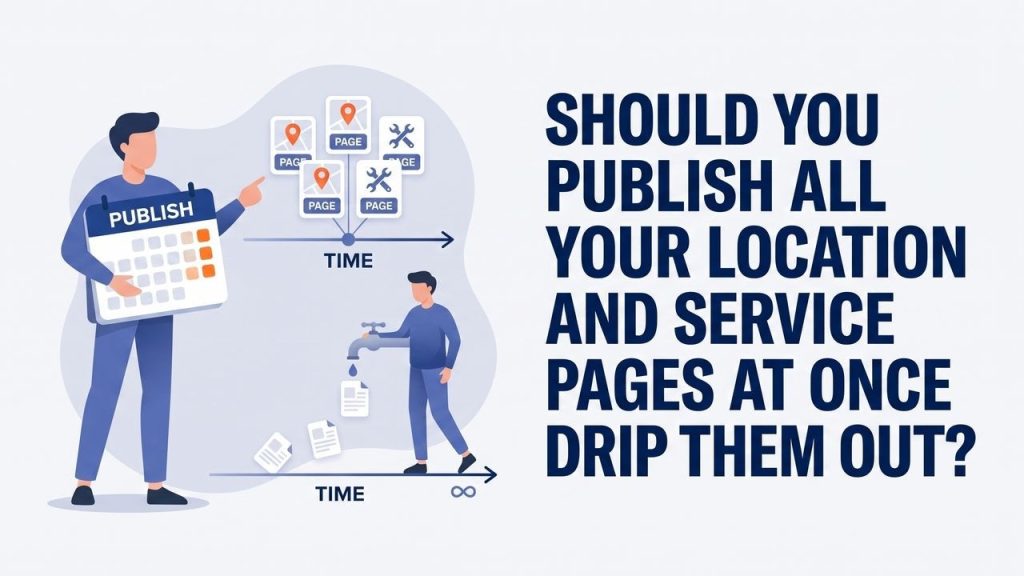
If we have five location pages and 20 service pages ready to go, should we publish them all at once? Or should we release a few at a time to help our local SEO?
Our answer is simple: publish the finished pages together. For a normal business website, we see no reason to hold back completed content just to follow a slow release schedule.
The better use of our time is getting those pages live, cleaning up our sitemaps, and helping Google find the URLs we want in search. Dripping pages out makes sense when the work is still in progress. It does not need to be a rule for a finished site.
Publish What Is Ready
Let’s stick with the example: five location pages and 20 service pages. That is a normal site build, not a huge project with thousands of pages.
If all 25 pages are complete, our choice would be to publish all 25. We would not create a schedule that spreads them across several weeks just because it feels safer for SEO.
In our experience, that kind of delay has not been needed for a regular client site or local SEO project. Once the work is done, we can shift our focus from holding pages back to helping Google discover them.
There is a clear difference between publishing a complete business website and using an old mass-page strategy. Years ago, when people built large numbers of pages at scale, a slow release could make more sense. That is not an approach we recommend now.
A normal website launch does not need to follow the rules of an old mass-page campaign.
When a Gradual Release Makes Sense
There is one practical reason to drip pages out: we may need to launch before all the content is finished.
Maybe the homepage and a few service pages are ready, but the remaining copy still needs work. In that case, we can launch the completed pages and add the rest as we finish them.
That is a work schedule, not a special SEO trick.
We can make the choice with two simple questions:
- Are the pages finished? If so, we would publish them together.
- Is some of the content still being written? If so, we would publish the ready pages and add the others as they are completed.
The point is not to rush unfinished content. It is to avoid delaying finished content without a clear reason. If the only thing holding back a page is an artificial release date, we would remove that roadblock.
Got SEO Questions? Get answers every week at 4pm ET at Hump Day Hangouts. Ask questions ahead of time, or live – just go to: https://semanticmastery.com/hdho (bookmark this!) 10+ years of insights given every week!
Get your checklist to help get better results with GBPs, faster.
Need DFY services for you Local SEO projects? Head over to Semantic Links.
After Publishing, Focus on Google Search Console
Once our location and service pages are live, the next step is to help Google find them.
We would head into Google Search Console and submit the site’s sitemap. A sitemap gives Google a list of URLs that we want it to discover and crawl. For this launch, that list should include the completed pages we want to appear in search.
This shifts our attention to a more useful question. Instead of asking how slowly we should release the pages, we can ask whether Google has a clear path to the pages we have already published.
Publishing and discovery are separate parts of the job. Getting the pages live is the first step. Giving Google a focused sitemap is the next.
Keep the Sitemap Clean
A sitemap should not become a dumping ground for every URL our website creates.
We often see sites with a long list of sitemaps for tags, categories, images, page-builder items, and other content. That can turn a simple setup into a mess.
Our approach is to keep it focused. We only want sitemaps for content that has a clear reason to be crawled and indexed.
For a basic site, that may mean:
- A page sitemap for the main website pages.
- A post sitemap if the site publishes posts that we want indexed.
- A location sitemap if a multi-location site has a reason to keep those URLs in a separate group.
We do not need every possible sitemap just because our website software can create it.
For example, tag archives or page-builder element URLs may not belong in the list we submit. Image and category sitemaps also deserve a review rather than automatic inclusion. If those URLs do not need to appear in search, we would leave them out of the submitted sitemaps.
The test is simple: does this sitemap contain content we actually want Google to crawl and index? If not, we should clean it up.
Submit the Individual Sitemaps Too
Some sites use a sitemap index. This is a parent file that points to several separate sitemaps.
For example, our sitemap index might link to a page sitemap and a post sitemap. A multi-location business might also have a separate location sitemap.
In that setup, our recommendation is to submit the index and each relevant child sitemap in Google Search Console. We want those individual lists submitted as well, rather than stopping at the parent file.
Our process would look like this:
- Open the sitemap index and check which sitemaps it contains.
- Remove unneeded sitemap types from the setup.
- Submit the sitemap index through Search Console.
- Submit each relevant individual sitemap, such as pages or locations.
More sitemaps are not the goal. A clear set of useful sitemaps is. We should be able to explain why each one is there.
Be Careful About Competing Blog Content
Blog posts deserve a separate note in local SEO.
Our preference is generally to keep blog content on a subdomain or on external branded assets rather than publishing it on the main local business site.
The concern is competing pages. When blog posts cover the same topics as our service or location pages, we can create overlap between pages that serve different roles.
That is why a post sitemap should not be treated as a required part of every local website. If we do publish posts on the site, the post sitemap should have a clear purpose. We do not need to add a blog just to have another type of content or another sitemap.
Use a Page Speed Test as an Extra Step
For a new domain, we also recommend running the homepage through Google’s page speed test.
The idea is to prompt a Google-run fetch of that page. We use this as an extra discovery step, not as a promise that the page will be indexed right away.
We can use the same approach on a few other important pages, too. But it can become tedious. A test may take around 30 to 45 seconds, so running it across every page is not always a good use of time.
We would start with the homepage, then use it on a small set of other pages if needed. It supports the launch process; it does not replace sitemap submission.
Keep the Launch Simple
For five finished location pages and 20 finished service pages, our plan is straightforward: publish them, submit clean sitemaps, and help Google discover the site.
We would only release pages gradually when the content itself is still being completed. Otherwise, there is no need to turn a finished website into a long publishing project.
Put the effort into a clean launch, not an artificial delay. Get the completed pages live, keep the sitemap focused, and make the next steps easy to follow.